
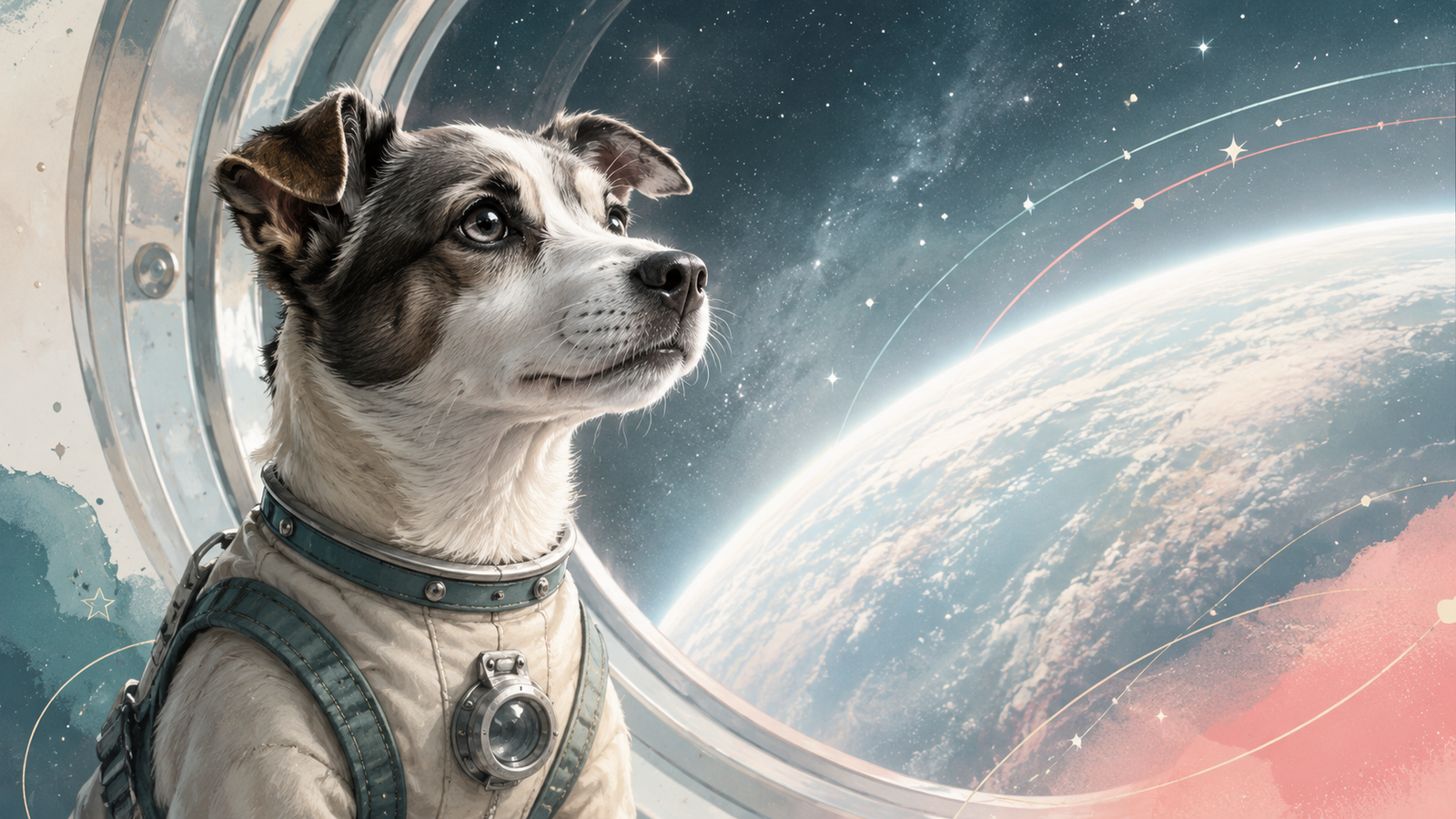
The Dogs Who Paved the Way to Space: Laika, Belka, Strelka and Others
Before Yuri Gagarin uttered his famous “Let’s go!”, others ventured into the unknown, unable to understand either the scale of the experiment or the risks they faced.
Dogs.
They were picked from the streets, trained to remain calm in confined spaces and tolerate noise and intense G-forces, placed in unfamiliar equipment, and prepared for conditions no living creature had ever experienced before.
Today, the names Laika, Belka and Strelka are known around the world. But behind the familiar photographs lies a much more complex story — one of scientific progress, animal behavior, trust in humans, and the cost of humanity’s first steps into space.
Why Were Dogs Chosen for Space Flights?
In the 1950s, no one yet knew whether a living organism could function normally beyond Earth.
How would the body cope with acceleration?
What would happen in weightlessness?
Would the heart be able to function normally?
How would breathing change?
Could a living creature survive the flight and return?
Before risking a human life, these questions needed to be investigated through experiments.
In the Soviet Union, dogs were chosen for this research.
The choice was not random. Soviet physiologists already had extensive experience working with dogs, and smaller dogs could fit into the very limited space available in early spacecraft.
The program mainly sought small dogs. Many candidates were ordinary mixed-breed dogs picked up from the streets.
Researchers believed that dogs accustomed to the hardships of city life would be resilient enough to adapt more readily to an unfamiliar environment.
Female dogs were chosen more often, partly because it was easier to design a waste collection system for them.
But being the right size was not enough.
A future “space dog” needed another essential quality — the ability to remain relatively calm in completely unfamiliar conditions.
How Dogs Were Prepared for Space Flights
The training was intensive.
The dogs were gradually accustomed to staying in small containers, wearing special equipment, and tolerating noise and vibration.
Centrifuges and other equipment were used to simulate some of the physical stresses of the upcoming flight.
Scientists monitored the animals’ heart rates, breathing and responses.
From a modern perspective, some of these training methods seem very harsh. This is an important part of the story that should not be romanticized.
From a behavioral perspective, however, there is an interesting point here.
Tolerating a Situation Does Not Mean Being Free From Stress
A dog may remain still.
They may not struggle to get away.
They may perform a familiar action.
But that does not necessarily mean they are calm.
Today, we have a much better understanding of how important it is to assess not only what an animal does, but also how they are feeling.
Body posture, breathing, facial expressions, ear movements, attempts to avoid contact and freezing are all part of a dog’s body language.
The story of the space dogs offers a striking example of how dangerous it is to judge an animal’s state solely on the assumption:
“They’re putting up with it, so everything must be fine.”
Endurance and well-being are very different things.
Dezik and Tsygan: Before Laika
When people talk about dogs in space, Laika is usually the first name that comes to mind.
But the story began earlier.
On July 22, 1951, Dezik and Tsygan made a high-altitude flight aboard a Soviet rocket.
The rocket reached an altitude of approximately 100 kilometers above Earth, after which the capsule carrying the dogs returned using a parachute system.
Both dogs survived the flight.
This was a crucial milestone in the program: the experiment showed that a living organism could survive a brief rocket flight and return to Earth.
More launches followed.
Not all of them ended successfully. Some dogs died as a result of accidents and technical failures.
Reliable spacecraft were still a long way off.
Laika: The First Dog in Orbit
On November 3, 1957, the Soviet Union launched Sputnik 2.
On board was a small mixed-breed dog named Laika.
She became the first animal to orbit Earth.
Animals had already made high-altitude and suborbital flights, but none had yet orbited Earth.
Laika was a former stray found on the streets of Moscow.
She was described as calm and comfortable around people.
But her mission had a tragic aspect.
Laika Was Never Meant to Return
Sputnik 2 had no system capable of bringing the dog safely back to Earth.
The mission itself was prepared in tremendous haste.
For many years, accounts of Laika’s death varied. It later emerged that she had survived for only a few hours after launch. One of the main causes was extreme heat inside the spacecraft following problems with its temperature control system.
Telemetry also recorded sharp increases in her heart rate and breathing during launch.
Laika’s flight was a major milestone in the history of space exploration.
In the history of human–animal relationships, it was one of the most painful chapters.
Today, it is impossible to speak of her achievement without also acknowledging that she did not choose this role.
Laika became a symbol of scientific progress, but also of the ethical questions that inevitably arise when humans use animals for their own purposes.
Belka and Strelka: A Flight That Brought Them Home
The next famous chapter in this story had a much happier ending.
On August 19, 1960, Belka and Strelka were launched into space.
Other living organisms were also on board, including mice, rats, plants and insects.
The spacecraft’s flight lasted about a day.
Belka and Strelka orbited Earth and returned safely.
This was a major achievement.
It had now been demonstrated not only that a living organism could survive in orbit, but also that a safe return after an orbital flight was possible.
This had direct implications for the future of human spaceflight.
Less than a year after Belka and Strelka’s flight, a human traveled into space.
Strelka Became a Mother
The story took an unexpected turn.
After returning to Earth, Strelka gave birth to six healthy puppies.
Soviet leader Nikita Khrushchev later gave one of them — little Pushinka — to the family of US President John F. Kennedy.
And so the offspring of a space dog ended up in the White House.
Pushinka later had puppies of her own.
A story that began with one of the defining symbols of the space race between the Soviet Union and the United States unexpectedly ended on an almost domestic note.
There Were Other Four-Legged Cosmonauts
Laika, Belka and Strelka became the most famous, but the list of dogs involved in the Soviet space program is much longer.
The flights of Chernushka and Zvezdochka in March 1961 were particularly important.
These missions tested the equipment and systems of the Vostok spacecraft.
Zvezdochka completed her flight successfully on March 25, 1961.
And on And on April 12, 1961, Yuri Gagarin embarked on the first human spaceflight in history.
Less than three weeks passed between the dog’s successful mission and the first human spaceflight.
In this case, saying that “dogs paved the way for humans to reach space” is far more than a poetic metaphor.
Their flights were part of the testing of systems that helped pave the way for human spaceflight.
What Can This Story Teach Dog Owners Today?
The space program of the mid-20th century existed in a very different historical and ethical context.
There is certainly no reason to replicate its methods in modern dog training.
But the story highlights several lessons that remain relevant today.
1. Dogs Have a Remarkable Ability to Adapt
Dogs can get used to a wide range of things.
New places.
Sounds.
Clothing and gear.
Unfamiliar surfaces.
Transportation.
Confined spaces.
New rules.
But adaptation is much more successful when new stimuli are introduced gradually and stay within each dog’s ability to cope.
This is why taking things gradually is so important in modern dog training.
2. Behavior Cannot Be Viewed Separately From Emotional State
A dog can follow a command while experiencing extreme stress.
Obedience alone tells us nothing about an animal’s well-being.
Good dog training involves observing not only what a dog does, but also how they feel while doing it.
3. Freezing Does Not Always Mean Calmness
This is especially important.
When a dog stops resisting, people sometimes interpret this as acceptance or relaxation.
But freezing can itself be a response to stress.
That is why body language needs to be considered as a whole, rather than drawing conclusions from a single signal.
4. Trust Changes the Learning Process
Dogs interact much better with people when they understand what is happening and feel safe around them.
Modern dog training is moving further away from the idea of forcing a dog to perform an action at any cost.
Our task is to create conditions in which a dog can learn.
Because learning is about more than commands and results.
It is also about the animal’s emotional state throughout the process.
Heroes or Victims?
Perhaps there is no single, simple answer to this question.
The space dogs played an enormous role in history.
The data gathered from their flights helped engineers and scientists take the next step — sending a human into space.
But the dogs did not choose to take part in these experiments.
Some returned home.
Some died.
Today, with a much deeper understanding of animal behavior, we can acknowledge the historical significance of these experiments while also questioning their ethics.
This does not diminish the achievements of science.
On the contrary, scientific progress also involves reexamining our own methods.
From the Streets of Moscow to the Stars
The history of space exploration is filled with rockets, satellites, engineers, scientists and cosmonauts.
But small mixed-breed dogs are part of that history too.
They once roamed ordinary streets, unaware that they would become part of one of humanity’s greatest technological breakthroughs.
Dezik and Tsygan.
Laika.
Belka and Strelka.
Chernushka.
Zvezdochka.
And many others.
Today, their story reminds us of more than humanity’s first steps toward the stars.
It also reminds us of something else:
a dog is willing to go remarkably far alongside a human. And that is precisely why our responsibility toward them is so great.
Frequently Asked Questions
Which Dog Was the First to Travel into Space?
In July 1951, Dezik and Tsygan became the first dogs to complete a successful high-altitude rocket flight and return alive.
Was Laika the First Dog in Space?
No. Dogs had already taken part in suborbital flights before her. Laika became the first dog — and the first animal — to orbit Earth.
Did Laika Return to Earth?
No. Sputnik 2 was not designed for a safe return. Laika died a few hours after launch because the spacecraft overheated.
Who Was the First to Return Alive from an Orbital Flight?
Belka and Strelka completed an orbital flight in August 1960 and returned safely to Earth.
Is It True That One of Strelka’s Puppies Lived in the White House?
Yes. After her spaceflight, Strelka had puppies. Nikita Khrushchev gave one of them, Pushinka, to the family of US President John F. Kennedy.